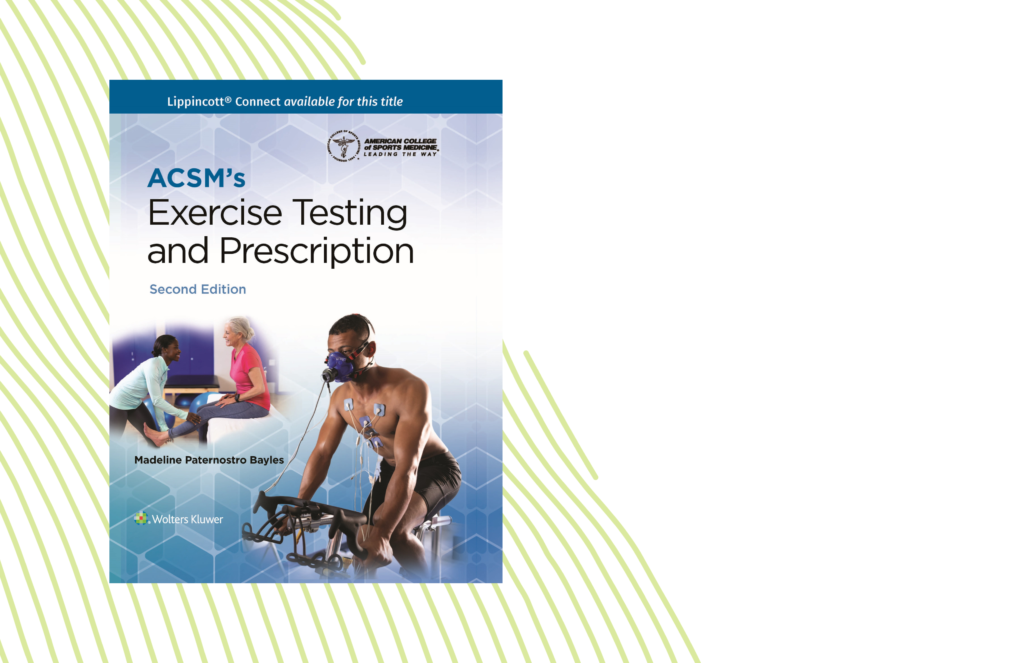
ACSM's exercise testing and prescription 2e book header
Book

The second edition guides the reader to a deeper understanding of topics from physical activity to screening to prescription. Extensive coverage on addressing exercise testing, prescription, and progression for a variety of special populations includes:

  • Frequency, intensity, time, and type (FITT) tables, which expand on the FITT principle presented in ACSM’s Guidelines for Exercise Testing and Prescription.
  • Real-world case studies selected specifically for the special population to bridge the gap between science and practice.
  • Integrated case study questions to guide the reader through assessment and prescription.
  • Additional resources – see this sample video for more. 
 

Student/individual online resources include: video clips highlighting appropriate assessments and exercises, online case studies, interactive question bank. 

Instructor resources include: PowerPoint lecture outlines, test and image banks. Instructors interested in adopting the new edition of this title can request more information here.

Learn how one instructor has utilized the Lippincott Connect platform for this title in his course.

Divider line green, blue, black

Learn More
5 things to know about creating an effective resistance training program infographic feature image
ACSM Unveils Landmark 2026 Resistance Training Guidelines — First Update in 17 Years

New evidence review of data from 30,000+ participants finds the biggest benefits come from consistency, not complicated programs The American

5 things to know about creating an effective resistance training program infographic feature image
5 Things to Know About Creating an Effective Resistance Training Plan | Infographic
Explore the economic cost of physical inactivity and discover how regular activity reduces healthcare expenses
ACSM and Parkinson's Foundation logos side by side
Parkinson’s Disease Exercise Recommendations Updated
ACSM and Parkinson's Foundation announce updated exercise recommendations for safe and effective workouts for those
person walking, data, steps
How many daily steps do you REALLY NEED for health?

Do you really need to get 10,000 steps a day to promote and maintain health?

Pregnancy Physical Activity Recommendations | Infographic
Explore the economic cost of physical inactivity and discover how regular activity reduces healthcare expenses
prescribing exercise for cognition in older adults infographic image
Principles for Prescribing Exercise for Cognition in Older Adults
Discover essential tips on prescribing exercise for older adults to optimize brain function and promote

GSSI Pre-Conference

The Physiology of Hydration: More Than Water Alone

This session explores the physiology of hydration through an integrated lens—examining how carbohydrate, sodium, flavor, and fluid interact to influence intake, absorption, retention, and performance. We’ll review current research on fluid balance, osmotic drivers, and palatability, highlighting mechanisms that underpin voluntary intake and thermoregulation. Attendees will gain insight into individualized strategies, including sweat profiling and timing approaches, to optimize euhydration and mitigate performance decrements associated with >2% body-mass loss. Practical applications will be linked to laboratory- and field-based research, ensuring translation from bench to field. This pre-conference equips you with evidence-based tools to support athlete hydration across diverse environments and sporting contexts. 

Divider line green, blue, black
  • Session 1: Sweating the detail: New insights on hydration considerations for athlete performance
    • Lewis James, PhD, Associate Professor in Human Nutrition in the School of Sport, Exercise and Health Sciences at Loughborough University
  • Session 2: Functional ingredients in fluid replacement beverages for athletes
    • Lindsay Baker, PhD, Director at the Gatorade Sports Science Institute
  • Session 3: The hydration toolkit: Practical approaches to athlete support
    • Floris Wardenaar, PhD, Associate Professor at the College of Health Solutions at Arizona State University