

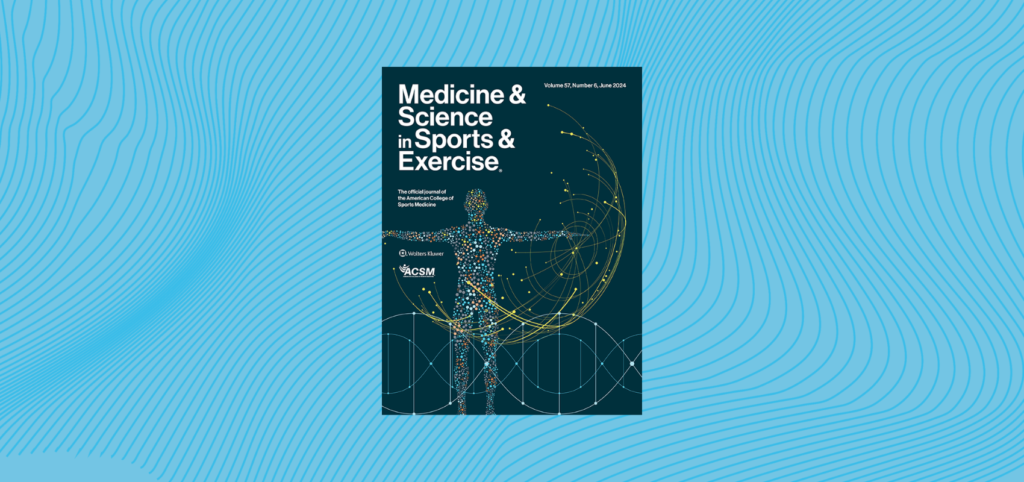
Medicine & Science in Sports & Exercise (MSSE), ACSM’s monthly peer-reviewed journal, is the leading multidisciplinary original research journal for members. Each issue features original investigations, clinical studies and comprehensive reviews on current topics in sports medicine and exercise science.
ISSN: 0195-9131
Journal Impact Factor: 4.0 – 17th of 136 in Sports Sciences
Total Cites = 43,794
Eigenfactor Score = 0.01354
PubMed Abbreviation: Med Sci Sports Exerc.
Article types:

The recent ACSM Annual Meeting in Salt Lake City provided a welcome opportunity to catch up on new science, resume acquaintances with colleagues from around the world and make new friends. It is always rewarding to celebrate the success of MSSE’s Paper of the Year winners (Erickson and colleagues’ “The Efficacy of Blood Flow Restriction Training to Improve Quadricepts Muscle Function after Anterior Cruciate Ligament Reconstruction”), outline the journal’s progress, and meet with Associate Editors and ACSM staff members to plan future activities. I’m hopeful that several of the excellent scientific sessions that I saw in Salt Lake will be converted into articles that are published in MSSE over the next few months. Please see below my selection of Highlighted Articles for this month’s issue.
In “Combining Noninvasive Tests of Different Physiological Dimensions Leads to Better Estimation of Muscle Fiber Type Composition in Humans,” Van de Casteele and colleagues present a rigorous validation study of noninvasive muscle fiber typing methods. They compared a diverse set of physiological tests with a strong criterion measure of muscle fiber type composition, derived from repeated biopsies of the vastus lateralis and gastrocnemius medialis. Their analysis revealed that combining post Wingate blood lactate concentration, high-velocity peak knee extension torque, muscle carnosine, and contraction time provided the most accurate estimate of muscle fiber type composition. These findings highlight the value of integrating noninvasive measures that capture distinct physiological dimensions and may guide sports practitioners seeking practical alternatives for estimating muscle fiber type composition in athletes.
Organized youth sport provides a valuable foundation for long-term health. In “Cardiometabolic Outcomes of Youth Participating in Organized Sport from Childhood to Early Adolescence,” Hliounakis and colleagues analyzed data from the Longitudinal Study of Australian Children (n = 1851) to determine whether distinct sport participation trajectories observed from age 6 to 11 were associated with cardiometabolic risk at age 12. They found that sustained engagement in team sport, alone or combined with individual sport, was associated with a more favourable risk profile, particularly among boys. Furthermore, youth who dropped out of sport had less favourable cardiometabolic risk profiles than consistent non-participants. These findings identify sport retention, especially in team-based settings, as a promising target for early cardiometabolic risk prevention.
While physical activity (PA) is consistently associated with reduced odds of depressive symptoms, specific aspects of PA such as type and diversity (allocation of weekly duration across reported activities) remain comparatively understudied. In “Physical Activity Characteristics and Symptoms of Depression: Findings from the Cooper Center Longitudinal Study,” Pavlovic and colleagues found that when multiple PA characteristics (volume, average intensity, duration, type, and diversity) were examined simultaneously, the most significant predictors of depressive symptoms, for both sexes, were average intensity and diversity of activity. These findings suggest that engaging in a variety of activities, some of which are high intensity, may be associated with lower odds of depressive symptoms. Some notable sex differences were observed. Specifically, very vigorous and long duration activities were inversely associated with depressive symptoms in women. Among men, predominant activity type, specifically aerobic or mixed endurance, was significantly related to reduced odds of depressive symptoms.

VAN DE CASTEELE, FREEK; VAN DER MEULEN, LENNERT; SABLAIN, MATTICE; VAN THIENEN, RUUD; LIEVENS, ELINE; DERAVE, WIM
HLIOUNAKIS, HOLLY; SANDERS, TAREN; GEORGE, EMMA S.; GUAGLIANO, JUSTIN M.
PAVLOVIC, ANDJELKA; LEONARD, DAVID; VUKOVICH, KATARINA; BARLOW, CAROLYN E.; SHUVAL, KEREM; MEERNIK, CLARE; DEFINA, LAURA F.

This session explores the physiology of hydration through an integrated lens—examining how carbohydrate, sodium, flavor, and fluid interact to influence intake, absorption, retention, and performance. We’ll review current research on fluid balance, osmotic drivers, and palatability, highlighting mechanisms that underpin voluntary intake and thermoregulation. Attendees will gain insight into individualized strategies, including sweat profiling and timing approaches, to optimize euhydration and mitigate performance decrements associated with >2% body-mass loss. Practical applications will be linked to laboratory- and field-based research, ensuring translation from bench to field. This pre-conference equips you with evidence-based tools to support athlete hydration across diverse environments and sporting contexts.
